 Astha SangrahASTHA SANGRAHhttps://asthasangrah.com
Shri Ganesh Chaturthi Vrat Katha
Ganesh Chaturthi Vrat Katha is the story of the false blame that fell upon Lord Krishna over the Syamantaka jewel, and how it was removed, recited on Bhadrapada Shukla Chaturthi, presented here in full.
Chapter 1 · Satrajit Receives the Syamantaka Jewel from Surya
Nandikeshwar said that everyone should listen to this story with a focused mind, on Bhadrapada Shukla Chaturthi, this most auspicious vow of Ganesh should always be observed with care. O best of the twice-born, whether man or woman, whoever observes this vow is at once freed from their troubles, all their disgrace is quieted and every obstacle is removed, this vow is the finest of all vows, renowned throughout the world, and most dear to Ganesh. Sanatkumar asked, 'Who first observed this vow in ancient times, and how did it come to spread in the mortal world, please describe Ganesh's vow to me in full.' Nandikeshwar said that this vow was first observed by the mighty Lord Vasudev Jagannath, that is, Krishna, when he was falsely accused, and Narada told him to observe this very vow to clear his name. Sanatkumar, astonished, asked again, 'O Nandikeshwar, Krishna is a god endowed with every virtue and glory, the creator, sustainer, and destroyer, dwelling within every heart, how did false blame ever come to fall upon such a Lord? This is a most astonishing thing, please describe this whole account in detail.'
Nandikeshwar continued: to relieve the earth of its burden, Jagannath himself, that is, Vishnu, took incarnation as the son of Vasudev, together with Haladhar Balaram. Because of the repeated invasions of Jarasandh, the emperor of Magadha, Krishna had a golden city, Dwarka, built in the sea. In that city of Dwarka, a Yadava named Ugrasen had two sons named Satrajit and Prasenjit. Living on the seashore, the mighty Satrajit performed penance to please the sun, remaining without food and gazing fixedly at the sun in worship. Lord Surya, pleased, appeared before Satrajit, and said in a calm, grave, and sweet voice, 'We are greatly pleased with you, ask of us whatever you desire.' Satisfied by Satrajit's devotion, Lord Surya took from his own neck a wondrous jewel and gave it to him, saying that it would give eight bhaar, that is, twenty-four maunds, of gold every day, and so it must be worn only while pure, for if worn in an impure state, it would destroy the one who wore it. Saying this, Lord Surya vanished. Wearing that jewel, Satrajit shone so brightly that he seemed to be Surya Narayan himself, and as he entered Dwarka, no one could tell, because of his radiance, who was approaching, only on drawing near did people realize that it was not the sun, but Satrajit. Seeing the Syamantaka jewel on Satrajit's neck, Lord Krishna's mind was drawn to obtain it, but he made no attempt to take it. Satrajit, for his part, grew suspicious that Krishna might ask him for the jewel, and out of this fear he gave the jewel to his brother Prasenjit.
Chapter 2 · Prasenjit's Death, and the False Accusation on Krishna
After some time, Prasenjit, wearing that very jewel, went hunting in the forest together with Krishna. Because he wore the jewel while impure, a lion killed Prasenjit as he rode. Seeing that lion with the jewel, the bear-king Jambavan killed the lion in turn, and, bringing the jewel to his cave, gave it to his son as a toy. Krishna, meanwhile, returned to Dwarka with his fellow hunters. All the people of Dwarka, seeing Krishna return alone, guessed that Krishna, out of greed for the jewel, had himself killed Prasenjit, and this rumour began to spread among everyone. This false accusation caused Krishna great sorrow, and, without telling anyone anything, he took a few people with him and went out of the city into the forest.
Going into the forest, Krishna found the spot where Prasenjit lay slain by a lion, and, going further, reached the place where the bear Jambavan had killed that lion, and, following the trail of blood, Krishna arrived at that cave. The bear-king's cave was most terrible and filled with deep darkness, so, leaving those who had come with him at the cave's entrance, Lord Krishna entered alone, and, dispelling the darkness with his own radiance, walked four hundred kos into the cave. On reaching that place, he saw a delightful spot and a palace, where Jambavan's son was swinging in a beautiful cradle, and in that cradle the same jewel hung as a plaything. Lord Krishna approached the child to take that jewel which served as his toy.
Chapter 3 · Battle with Jambavan, and Recovery of the Jewel
A moon-faced, lotus-eyed young woman was rocking that cradle, saying softly to the child, 'My darling, why are you crying, see, Prasenjit was killed by a lion, and our father, having killed that lion, has brought you this Syamantaka jewel to play with.' Seeing lotus-eyed Krishna, that young woman said softly, 'Leave this place before my father's gaze falls upon you.' Hearing this, the mighty Krishna laughed and blew his conch, the Panchajanya, and at that sound the bear-king Jambavan rose in alarm and came to him, and then a terrible battle broke out between Krishna and Jambavan. At this sight all the women began to shriek, and the cave's residents were struck with astonishment. Meanwhile, those waiting for Krishna at the cave's entrance, believing him dead, returned to Dwarka on the seventh day. Inside the cave, Krishna and Jambavan fought a continuous wrestling battle for twenty-one days, until at last Krishna wore down Jambavan's battle-fury, and then, recalling events of the Treta Yuga, Jambavan recognised the Lord.
Jambavan said, 'I am unconquerable even by all gods, demons, yakshas, nagas, gandharvas, and pishachas, none of them can stand before me, O lord of lords, you have defeated me, so it is certain that you are the lord of the gods, I have now understood that you are Vishnu's own splendour, you who once, as the bow-bearing Rama, fought for Vaidehi.' When Jambavan had recognised him in this way, Lord Krishna, stroking Jambavan's head with his gracious hand, said affectionately, 'O bear-king, because of this jewel a false accusation has fallen upon me, and it is to obtain this jewel and clear that accusation that I have come into your cave.' Hearing the Lord's words, Jambavan happily gave his daughter Jambavati to him, and gave the jewel too as her dowry. Lord Krishna accepted the maiden and the jewel, married Jambavati, and returned to Dwarka in good spirits, together with her and the jewel. Seeing Krishna return with his newly wedded wife and the jewel, all the people of Dwarka began to celebrate. Krishna, pleased, went with his friends to the assembly hall of the Yadavas, where he related the whole account of the jewel's disappearance and recovery, and, calling Satrajit, who was present in the assembly, he returned the jewel to him. Handing over the jewel before the Yadava assembly in this way, Krishna was cleared of the false accusation. Satrajit, being wise, felt ashamed of his error on receiving the jewel back, and as a result he also gave his daughter Satyabhama in marriage to Krishna.
Chapter 4 · Shatadhanva's Treachery, and Balaram's Anger
After this, some corrupt-hearted Yadavas, including Shatadhanva and Akrura, began to bear enmity toward Satrajit in order to obtain the jewel. Once, while Krishna was away, Shatadhanva killed Satrajit and took the jewel for himself. When Krishna returned, Satyabhama told him the whole matter. Hearing this, Krishna told Balaram that Shatadhanva had killed Satrajit and stolen the jewel, and that he must now be fleeing in fear. When Shatadhanva learned of this, he grew afraid, handed the jewel to Akrura, mounted a mare, and fled southward. Balaram and Krishna gave chase in a chariot, and after a hundred yojanas his mare was killed, whereupon he fled on foot; Krishna ran and caught him, and slew him. Krishna, eager for the jewel, said to Balaram, who was seated in the chariot, 'Brother, the jewel was not found on him.'
Hearing Krishna's words, Balaram grew furious and said, 'Krishna, you have always dealt in deceit, no one is more greedy or sinful than you, when you do not hesitate to kill even your own kin out of greed for wealth, what brother or kinsman would ever stand by you?' Krishna then tried, with solemn oaths, to appease Balaram, but Balaram, saying, 'It is shameful to bear the torment of such false accusation,' departed for the land of Vidarbha, while Krishna returned to Dwarka in his chariot. On Krishna's return, the people of Dwarka again began to say that Krishna had done wrong in driving his elder brother Balaram out of Dwarka. Because of the jewel, even his own brother Balaram had turned against him, and accusations of one kind or another kept falling upon him again and again, and so, wondering how much longer such disgrace could be borne, Krishna sat troubled, and it was at that very moment that Narada arrived.
Chapter 5 · Ganesh's Curse Upon the Moon
When the Lord had courteously seated him, Narada said, 'My lord, why do you appear so troubled, what worry has come upon you, O Keshav, tell me the whole matter.' Krishna said, 'O sage Narada, I am being falsely blamed again and again, and this fills me with great distress, I take refuge in you, please free me of this worry.' Narada said, 'My lord, I know the cause of the blame that falls upon you, you looked upon the moon on Bhadrapada Shukla Chaturthi, and it is for this reason that you keep being falsely accused.' Hearing this, Krishna asked, 'O sage, how does looking at the moon on Chaturthi bring blame, when people look at the moon on Dwitiya and receive good fortune from it?' Narada said, 'Ganesh himself cursed the moon, who was proud of his beautiful form, that whoever looks upon him on this day would come to bear pointless disgrace in society.' Krishna asked, 'O great sage, why did Ganesh curse the nectar-showering moon, please describe this excellent tale in full.'
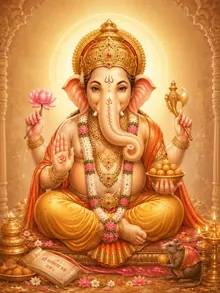
Narada answered, 'In ancient times, Brahma, Vishnu, and Shiva together bestowed upon Ganesh the eight siddhis and nine treasures in the form of wives, and then Brahma, the lord of creation, worshipped Ganesh according to scriptural rites, made him foremost among all the gods, and began to praise him. Hearing such praise, Ganesh, pleased, said to Brahma, whatever your wish, ask it as a boon, and I shall grant it. Brahma said, Lord, let there be no obstacle to me in the work of creation. Ganesh, pleased, said, so be it. Having received the boon he wished for, Brahma returned to his own realm. After this, Ganesh, wandering wherever he pleased, travelled from Satyaloka by the path of the sky and reached Chandraloka, the moon's realm. The handsome moon, seeing Ganesh's strange form, his long trunk, ears like winnowing fans, long tusks, heavy belly, and his mount, a mouse, mocked him and burst out laughing. Enraged by the moon's laughter, Ganesh's eyes turned red with fury, and he cursed the moon, saying, you take pride in your handsome, pleasing form, so from today, whoever looks upon you on Bhadrapada Shukla Chaturthi shall come to bear false blame. Hearing this terrible curse, all the moon's joy turned to gloom, and, ashamed, he went and hid in the water, from that day the moon has dwelt with his reflection cast upon the water.'
Chapter 6 · The Remedy for the Curse, and Krishna's Vow
The moon's hiding in this way brought great dismay to the gods, sages, and gandharvas, and they all went, under the leadership of Indra, to the realm of the grandsire Brahma, and told him the whole matter. Brahma said, 'O gods, neither I, nor Vishnu, nor Indra and the other gods can undo Ganesh's curse, so you must all take refuge with him alone, he alone can free the moon from the curse.' When the gods asked what to do, Brahma told them that Ganesh should be worshipped with great care especially on the night of the Krishna Chaturthi, offering him malpua and laddus made with pure ghee, and giving Brahmins gifts according to one's means. Learning this method, the gods sent Brihaspati, the guru of the gods, to the moon, and Brihaspati went and taught the moon this method. The moon observed the vow and worship of Ganesh by this method, and, pleased, Lord Ganesh appeared before him. Seeing Ganesh, the moon praised him and begged forgiveness, saying, 'Lord, out of pride I mocked you, be pleased with me.' Ganesh, pleased, asked, 'Ask whatever boon you wish.' The moon said, 'Let everyone look upon me as before once more, and by your grace let my sin and curse be removed.' Hearing this, Ganesh said, 'O moon, I can give you another boon in place of this one, but this I cannot grant', meaning that the curse of Bhadrapada Shukla Chaturthi could not be entirely undone.
Hearing these words from Ganesh, the remover of obstacles, Brahma and the other gods, greatly afraid, prayed to the devoted-loving Ganesh, 'O lord of lords, please free the moon from this curse, this is the one boon we all seek from you.' Hearing this, Ganesh said respectfully, 'You are all my devotees, so I grant you the boon you desire, those who look upon the moon on Bhadrapada Shukla Chaturthi shall certainly incur blame, of this there is no doubt, but those who regularly look upon the moon on the Shukla Dwitiya of every month shall not have to suffer the ill effect of the Bhadrapada Shukla Chaturthi sighting.' Narada said, 'O Krishna, from that day everyone began respectfully looking at the moon on Dwitiya, so you too should observe this vow, and your blame will surely be cleared.' On Narada's instruction, Krishna performed this vow and observance, and by doing so Krishna was freed forever from that false blame. Narada says that whoever hears this account of the Syamantaka jewel and this story of the moon shall never incur the fault of looking at the moon on Bhadrapada Shukla Chaturthi, and so this sorrow-removing story should certainly be heard by all. Whether man or woman, whenever any trouble comes, observing this vow fulfils all their wishes, and by the grace of Ganesh, the remover of obstacles, every good thing in the world becomes easily attainable.
How to Read Shri Ganesh Chaturthi Vrat Katha
On every Krishna Paksha Chaturthi, and especially on Bhadrapada Shukla Chaturthi, install an image of Ganesh (of gold, clay, or fashioned from fragrant flowers), offer laddus, hear the story, feed a Brahmin and give a gift, and eat only sweet foods yourself, avoiding salty ones. Avoid looking at the moon on this day; if it happens by mistake, recite: 'The lion killed Prasenjit, and Jambavan sent the lion to the abode of death, child, do not weep, here is your Syamantaka jewel.' Looking regularly at the moon on the Shukla Dwitiya of every month guards against this fault.
About Shri Ganesh Chaturthi Vrat Katha
The Ganesh Chaturthi Vrat Katha is told across six chapters. In the first three, Satrajit receives the Syamantaka jewel from the sun, Prasenjit dies while wearing it, the blame falls upon Krishna, and he fights Jambavan and recovers the jewel. The fourth tells of the jewel's theft by Shatadhanva and Balaram's fury. The fifth and sixth tell how Narada reveals that the blame comes from looking at the moon on Bhadrapada Shukla Chaturthi, and recount the story of Ganesh's curse upon the moon and its remedy, after which Krishna himself observes this vow and is freed from blame.
This vow is observed especially on the Shukla Chaturthi of the Bhadrapada month, on the occasion of Ganesh's birth festival, seeking protection from false blame and obstacles. This page presents the full text of all six chapters in plain Hindi, with adjustable text size and print support.
The Ganesh Chaturthi Vrat Katha has no named author. It is traditionally presented as the story Nandikeshwar told Sanatkumar, within which Narada in turn tells it to Lord Krishna. The text presented here is adapted from the 'Bhadrapada Shukla Ganesh Chaturthi Vrat Katha (the Syamantaka Jewel Story)' as printed in a published Hindi booklet, which is part of a larger collection giving a different Ganesh Chaturthi story for each of the twelve months, only the Bhadrapada Shukla Chaturthi story, that is, the story for the annual Ganesh Chaturthi, is given on this page. Some portions of the printed source copy were badly damaged and difficult to read, so the wording there was reconstructed based on the well-known, widely told tradition of the Syamantaka jewel story, though the events and their sequence were kept faithful to the original source. Other printed editions may use different wording.
Frequently asked questions
How many chapters does the Ganesh Chaturthi Vrat Katha have?
It has six chapters in total, traditionally read or heard together as one complete text.
When is Ganesh Chaturthi observed?
It is observed on the Shukla Chaturthi of the Bhadrapada month, which is also celebrated as Ganesh's birth festival.
Why is looking at the moon forbidden on Ganesh Chaturthi?
As the story describes, Ganesh, angered at being mocked, cursed the moon so that whoever looked at him on this day would bear false blame, Lord Krishna himself was falsely accused over the Syamantaka jewel because of this very curse.
What should be done if the moon is seen by mistake?
As described in the puja vidhi, one should recite the verse beginning 'The lion killed Prasenjit...', and looking regularly at the moon on the Shukla Dwitiya of every month also guards against this fault.
Is this the story for every month's Ganesh Chaturthi?
No, the source booklet gives a different story for the Krishna Paksha Chaturthi of every month. This page specifically presents the Syamantaka jewel story for Bhadrapada Shukla Chaturthi, the annual Ganesh Chaturthi.