 Astha SangrahASTHA SANGRAHhttps://asthasangrah.com
Sheetala Ashtami (Basoda) Vrat Katha
The Sheetala Ashtami Vrat Katha is the story of Mata Sheetala's arrival at Dungri village on earth, a potter-woman's true devotion and service, and the boon she received, recited on Chaitra Krishna Ashtami, presented here in full.
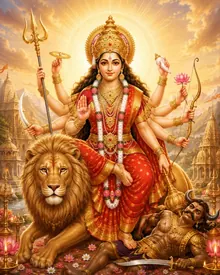
Chapter 1 · Sheetala Mata's Arrival at Dungri Village
Once, it occurred to Mata Sheetala to go down to earth and see for herself who worshipped her and who held her dear. With this thought, she descended upon a village called Dungri in Rajasthan, only to find that it had no temple to her, nor anyone who worshipped her.
As she made her way through the village's narrow lanes, someone suddenly emptied the boiling starch-water drained from cooked rice off a rooftop, and it landed directly on Mata Sheetala. The scalding water raised blisters across her skin, and an unbearable burning spread through her body.
Distraught with pain, she ran about the village calling out for someone to help her, for her body had been badly scalded. But not a single person in that entire village came forward to help her.
Chapter 2 · The Potter-Woman's Service and the Goddess's Revelation
A potter-woman sitting at her doorway noticed this badly burnt old woman writhing in the pain of her blisters. Moved by the sight, she called her over and said: mother, sit here, I shall pour cool water over you. She then poured plenty of cool water over the old woman, and brought out some raabri left from the night before along with a little curd for her to eat. This cool millet-flour raabri and curd brought the old woman some relief.
The potter-woman then said that her hair was badly tangled, and offered to comb it out and plait it for her. As she combed through the hair, her gaze suddenly fell on the back of the old woman's head, where another eye lay hidden among the strands.
The moment she saw this, the frightened potter-woman turned to flee, but the old woman stopped her, saying, daughter, do not be afraid, I am no evil spirit, but the goddess Sheetala herself, and I came here only to learn who worships me. So saying, she revealed her true form, four arms, precious jewelled ornaments, and a golden crown upon her head.
Chapter 3 · The Removal of Poverty and the Boon
Seeing the goddess in her true form, the potter-woman grew anxious about how, in her poverty, she could possibly seat the deity properly. Noticing her distress, the goddess asked what troubled her mind so. With folded hands and tearful eyes, the potter-woman said: mother, there is nothing but want in my home; I have no stool, no seat at all, how could I possibly seat you here?
Pleased by her humility, the goddess seated herself upon a donkey standing in the courtyard, and, taking a broom in one hand and a basket in the other, swept up every trace of poverty from the house, gathered it into the basket, and cast it far away. She then said to the potter-woman, I am satisfied with your sincere devotion; ask of me now whatever you wish.
The potter-woman joined her hands and pleaded, goddess, my only wish is that you dwell forever in this village of Dungri. And just as you swept away the poverty of my hut, so may poverty leave the home of every devotee who worships you with faith on the Saptami after Holi and offers you cool water, curd, and food kept overnight on Ashtami, may the women who worship you keep their marital fortune unbroken and their laps ever full. And may any man who, on this day, forgoes a haircut and does not send his clothes to be washed, but instead offers you cool water and a coconut and eats stale food with his family, never see his trade fall into poverty.
Saying 'tathastu' (so be it), the goddess granted every boon that had been asked, and further decreed that the foremost right to worship her on earth would always belong to the Kumhar (potter) community. From that day on, Mata Sheetala came to dwell forever in Dungri village, which came to be known as 'Sheel ki Dungri', counted today among India's major Sheetala shrines, where a large fair is held on Sheetala Saptami.
How to Read Sheetala Ashtami (Basoda) Vrat Katha
On the evening of Saptami after Holi, prepare food in advance for the next day. On Ashtami morning, bathe and worship Mata Sheetala without lighting the hearth, offer her cold water, curd, and stale food, listen to the katha, and eat that same food as prasad.
About Sheetala Ashtami (Basoda) Vrat Katha
The Sheetala Ashtami Vrat Katha tells of Mata Sheetala's arrival at Dungri village on earth, a potter-woman's true devotion and service, and the removal of poverty from her home along with the boon she received. This page has three chapters, the first covers Mata Sheetala's arrival at Dungri village and the pain she suffered there, the second the potter-woman's service and the Mother's revelation of her true form, and the third the removal of poverty and the boon granted to the potter-woman.
This katha is recited eight days after Holi, on Chaitra Krishna Ashtami, that is, on Sheetala Ashtami (Basoda), during the worship of Mata Sheetala. This page presents the full text of all three chapters in plain Hindi, with adjustable text size and print support.
The Sheetala Ashtami Vrat Katha has no single named author or Puranic source, it is a traditional folk narrative associated with Dungri village in Rajasthan, circulated both orally and in print around the occasion of Sheetala Ashtami worship. The story given here follows the events and sequence of this circulating folk account, but its wording has been composed independently, so that it is not a word-for-word copy of any single website's or publication's text.
Frequently asked questions
How many chapters does the Sheetala Ashtami Vrat Katha have?
It has three chapters in total, traditionally read or heard together as one complete text.
Why did Mata Sheetala come to Dungri village?
Mata Sheetala came to earth to see who worshipped her, but Dungri village had no temple to her and no one worshipped her there, and during this visit, someone throwing boiling water caused blisters to rise on her body.
What boon did the potter-woman receive from Mata Sheetala?
Pleased by the potter-woman's true service, Mata Sheetala removed the poverty from her home, promised to settle permanently in Dungri village, and granted a boon that poverty would be removed from the home of every future devotee who worships her with true devotion, and that women's marital fortune and children would remain secure.
How did the village come to be called 'Sheel ki Dungri'?
After Mata Sheetala became permanently established in Dungri village, the village came to be known as 'Sheel ki Dungri', which today is known as one of India's major Sheetala temples.