 Astha SangrahASTHA SANGRAHhttps://asthasangrah.com
Shri Chitragupta Yama Dwitiya Vrat Katha
The Chitragupta Yama Dwitiya Vrat Katha is the origin story of Lord Chitragupta's birth, the Kayastha lineage, and the tradition of eating at one's sister's home on Bhai Dooj, recited on Kartik Shukla Dwitiya, presented here in full.
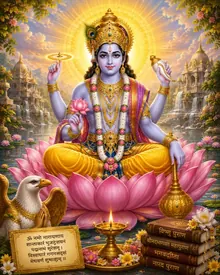
Chapter 1 · The Origin of the Kayasthas and the Birth of Chitragupta
Shri Bhishma asked: O great sage! The men known in this world by the name 'Kayastha', in which lineage were they born, and to which varna do they belong? I have a great wish to hear this story, so please, since only you are capable of resolving this doubt, narrate this sacred tale.
Thus questioned, the sage Pulastya spoke with a pleased mind to Bhishma, son of Ganga, O Gangeya! I shall now describe to you the origin of the Kayasthas, listen.
Listen now to what you have not heard before. The unmanifest, tranquil Brahma, grandsire of the worlds, brought forth this world of the moving and unmoving, sustains it, and will in the end destroy it too. I shall tell you how, in ancient times, he fashioned this creation, Brahmins from his mouth, Kshatriyas from his arms, Vaishyas from his thighs, and Shudras from his feet. In the same way he brought forth all creeping creatures with two, four, and six feet, and, at that very same time, the moon, the sun, and the other planets and countless other beings. O Bharata, Brahma then summoned his eldest son, radiant as the sun, and commanded him, O Suvrata! Protect this world with diligence.
Listen now to what Brahma did after commanding his eldest son to sustain creation. With a focused mind, Brahma remained absorbed in samadhi for eleven thousand years, and at last his mind grew still. Then, from his very body, there appeared a being with mighty arms, a dark complexion, lotus-like eyes, a conch-like neck, a face like the moon, radiant and highly intelligent, holding a pen and an inkpot in hand, of wondrous form, with eyes fixed in meditation. O Gangeya! Brahma emerged from his samadhi, looked this being up and down, and asked: who stands before us? Hearing this question, the being replied: O Nath! O Vidhe! I have been born of your own body, of this there is no doubt. Now you alone should give me a name, and also tell me the duties fit for me to perform.
Hearing this, Brahma, pleased with the being born of his own body, laughed and said: since you have been born from my body (kaya), your designation shall be 'Kayastha', and on earth you shall be known by the name 'Chitragupta'. O child! For the settling of dharma and adharma, your dwelling shall be fixed in the auspicious city of Dharmaraja. Uphold, in due order, the dharma proper to your own varna, and bring forth sons. Having granted this weighty boon, Brahma vanished from that very place.
Pulastya said: O Bhishma, increaser of the Kuru line! Hear the names of the offspring born of Chitragupta, Gaud, Mathur, Bhatnagar, Senak (Saxena), Ahigana, Srivastava, Ambashtha, Karan, and others, all born skilled in every scripture. Then the wise Chitragupta sent his sons out over the earth, and taught them the means of dharma, the worship of the gods, the shraddha and tarpan offered to ancestors, the sustenance of Brahmins, and the constant service of guests.
O sons! Strive for the welfare of all three worlds, and, desiring heaven, be sure to worship the goddess Mahishasuramardini, who is the form of maya and of prakriti, the destroyer of Chanda and Munda, and the bestower of every siddhi. By her power the gods attained siddhi and went to the heavenly realm, becoming forever entitled to a share of the yajna. So you too must worship her with the finest sweets, that you may attain siddhi as well. Take refuge in the Vaishnav dharma and uphold this command of mine, having said this to his sons, Chitragupta departed for heaven, and remained forever established under the authority of Dharmaraja. O Bhishma! Thus have I told you of the origin of the Kayasthas and of Chitragupta's own station. Now let me tell you a wondrous account of how Chitragupta's power came to be revealed.
Chapter 2 · The Story of King Saudas and the Vidhi of Chitragupta's Worship
Pulastya said: In this world there was a king named Saudas, who, not knowing dharma from adharma, remained forever engaged in sinful acts. Hear how this sinful, ill-conducted king, devoid of righteous deeds, nevertheless came to enjoy the fruit of merit in heaven. Ignorant even of statecraft, this king had a proclamation made throughout his kingdom that no one in his realm was to give in charity, or perform dharma, havan, shraddha, tarpan, the honouring of guests, japa, observances, or austerity.
The Brahmins devoted to the Goddess left that king's land and went to other countries, and those who remained never again performed yajna, havan, shraddha, or tarpan. O Gangeya! From that time on, no one in that kingdom performed any yajna, havan, or other meritorious act, and merit itself departed from that land.
On the auspicious tithi of Kartik Shukla Dwitiya, the Kayasthas, having purified themselves, were worshipping Chitragupta with devotion, using incense, lamps, and other auspicious offerings. By chance King Saudas was passing that way, and he asked whose worship this was. The Kayasthas replied: O king! We are performing this auspicious worship of Shri Chitragupta. Hearing this, the king said: I too shall worship Chitragupta. He then bathed according to the proper rites and, with a heart full of faith, performed that same worship. By this act of devoted worship alone, King Saudas was instantly freed of sin, and by Chitragupta's grace attained the realm of the gods. O best of kings! This is the wondrous account I have told you, born of Chitragupta's power.
Hearing this, Bhishma asked the great sage Pulastya, O best of sages! By what vidhi and what mantra did that king perform his worship there, by which Saudas attained heaven? Pulastya said: O Bhishma! I shall tell you the vidhi for worshipping Chitragupta. One should worship him with ghee-based naivedya, seasonal fruits, sandalwood, flowers, incense, a lamp, offerings of many kinds, and silken cloth, playing the bheri drum, the conch, the mridang, and other instruments, with a heart full of devotion. Place a vessel filled with sugar atop a kalash filled with water, and at the time of worship, give a gift to a Brahmin with care, reciting the mantras of homage to Chitragupta with a devoted mind.
In this very manner, O Bhishma, increaser of the Kuru line, one should worship Chitragupta with proper resolve. In this way King Saudas continued to rule his kingdom while devotedly performing this worship, and after some time, he died.
Chapter 3 · The Origin of Yama Dwitiya and Bhishma's Boon
O Bharata! At that very instant, the messengers of Yama carried King Saudas off to the fearsome realm of Yamaloka. There Dharmaraja asked Chitragupta, this Saudas is a king ever engaged in sin and ill conduct, who made his own subjects sin as well. Chitragupta, the wise knower of dharma and adharma, laughed and said: O son of the Sun! Though this king is known on earth as a sinner, it is by your grace that I am worshipped on earth, and this king worshipped me with true devotion. Therefore, O lord, I am satisfied with him, let this king go to Vishnu's own abode, Vaikuntha. By Yamaraja's command, King Saudas departed for the realm of Vaikuntha.
Pulastya said: whoever else, whether an ordinary man or a Kayastha, worships Chitragupta on this earth, shall be freed from sin and attain the supreme state. Therefore, O Gangeya, you too should worship him according to the vidhi, that you may attain a realm difficult to reach. Hearing the sage's words, Bhishma, his heart pleased, then also worshipped Chitragupta there with devotion.
On Kartik Shukla Dwitiya, Yamaraja had once eaten a meal at the home of his sister Yamuna, and it is for this reason that this tithi came to be known in the world as 'Yama Dwitiya'. Pleased by her brother's love, Yamuna granted Yamaraja the boon of increased life. It is for this reason that eating from a sister's hand on this tithi causes wealth, fame, and lifespan to increase well.
On this tithi, a brother should give his sister dakshina according to his means and the proper rites, and Kayasthas should worship Chitragupta at the sister's home itself, worshipping him with brightly coloured flowers, red sandalwood, black datura blossoms, and shami leaves, and offering him naivedya of jaggery-laddus.
Thus worshipped, the pleased Chitragupta granted Bhishma a boon, O mighty-armed one! By my grace, death shall not come to you until you yourself choose to remember it. Having granted this boon, Chitragupta departed for heaven. Those wise men who worship Chitragupta by this vidhi shall enjoy delightful pleasures in this world, and shall at last, without doubt, attain the imperishable realm of Vishnu. And those noble men who hear this divine tale of Chitragupta and the origin of the Kayasthas with a devoted mind shall be freed from every ailment and live long, attaining in the end the realm of Vishnu, as sages of austerity do.
How to Read Shri Chitragupta Yama Dwitiya Vrat Katha
On Kartik Shukla Dwitiya, bathe, clean the pen and inkpot, and worship Lord Chitragupta with ghee-based naivedya, seasonal fruits, sandalwood, flowers, incense, a lamp, and silk cloth. Place a vessel filled with sugar atop a kalash filled with water, and give a gift to a Brahmin according to one's means. At the sister's home, worship Chitragupta again with colourful flowers, red sandalwood, black datura, and shami leaves, offering jaggery-laddus as bhog, and let the brother give his sister dakshina according to his means.
About Shri Chitragupta Yama Dwitiya Vrat Katha
The Shri Chitragupta Yama Dwitiya Vrat Katha tells of Lord Chitragupta's birth and the origin of the Kayastha lineage, King Saudas's liberation through the worship of Chitragupta, and how the day came to be called 'Yama Dwitiya' after Yamaraja ate a meal at his sister Yamuna's home. This page has three chapters, the first covers Chitragupta's birth and the origin of the Kayastha lineages, the second King Saudas's story and the puja vidhi, and the third the origin of Yama Dwitiya and the boon granted to Bhishma Pitamaha.
This katha is recited during the worship of Lord Chitragupta on Kartik Shukla Dwitiya, that is, on Bhai Dooj. This page presents the full text of all three chapters in plain Hindi, with adjustable text size and print support.
The Shri Chitragupta Yama Dwitiya Vrat Katha itself identifies, at its close, as a tale from the Uttara Khanda of the Shri Padma Purana. The text presented here is a faithful transcription of the katha given in a Sanskrit-Hindi booklet published in Kashi in 1944 ('Shri Chitragupta Pujan Vidhi, with the Shri Chitragupta Yamadwitiya Vratakatha', edited by Gyanchandra), using only the Hindi meaning given alongside each Sanskrit verse in the booklet, not the Sanskrit verses themselves, with only clear printing errors corrected. Note that this particular source has Bhishma receiving his boon of choosing the time of his own death from Chitragupta himself, whereas the well-known Mahabharata account has this boon given to Bhishma by his father Shantanu, this is a distinctive detail of this particular booklet, and other popular retellings may differ.
Frequently asked questions
How many chapters does the Chitragupta Yama Dwitiya Vrat Katha have?
It has three chapters in total, traditionally read or heard together as one complete text.
How did the Kayastha lineage originate?
According to the story, after a long samadhi, a radiant being holding a pen and inkpot appeared from Brahma's body, whom Brahma named 'Kayastha' (born of the 'kaya', or body) and gave the name 'Chitragupta', entrusting him with judging dharma and adharma in Dharmaraja's city.
Why is the day called Yama Dwitiya?
On Kartik Shukla Dwitiya, Yamaraja ate a meal at his sister Yamuna's home, and, pleased by her affection, granted her the boon of increased longevity, this is why the tithi is called 'Yama Dwitiya'.
What did King Saudas gain from worshipping Chitragupta?
The sinful King Saudas, seeing the Kayasthas worshipping Chitragupta, performed that same worship with devotion, which instantly freed him from sin, and after death, on Chitragupta's own recommendation, he attained Vaikuntha (Vishnu's realm).