 Astha SangrahASTHA SANGRAHhttps://asthasangrah.com
Annapurna Mata Vrat Katha
The Annapurna Mata Vrat Katha is the story of the poor Brahmin Dhananjay's past-birth secret, the prosperity he gained through the power of the Annapurna vow, and his eventual direct vision of Shiva and Annapurna, recited during the month of Margashirsh, presented here in full.
Chapter 1 · Yudhishthira's Question and the Story of Rama and Lakshmana
In the forest, King Yudhishthira said to Shri Krishna, O lord of the gods! Living here in exile, I suffer greatly over food. Sometimes by day, sometimes by night, sometimes little, sometimes much, sometimes dry and plain, sometimes without any flavour at all, eating such irregular forest food, and sleeping upon the bare ground, O Keshava, hunger torments me sorely. Months have passed living on roots, fruit, and greens, yet my mind finds no peace.
Lord Shri Krishna said: in the Treta Yuga, Lord Shri Ramachandra himself, at his father Dasharatha's command, gave up his entire kingdom and dwelt in the Dandaka forest with Sita and Lakshmana. One day Lakshmana wandered the whole forest in search of food but found nothing at all, and so, returning at dusk, he bowed to Shri Ramachandra. At that moment his eyes filled with tears, and he sat down silently, overcome.
Then Shri Rama spoke sweetly to his brother, my son, do not grieve, for this world reaps fruit according to each one's own fortune. Whatever a man gives in charity in a past birth, he receives the fruit of it in this very birth. Those who gave fine, delicious food in a past life now, in this one, obtain every kind of food in abundance, while those who never gave in charity wander as we do, see, the earth is full of grain, yet we go hungry for want of it. O Lakshmana, surely we once failed to feed Brahmins, and it is for this very reason that we have come to this state; so understand it as the fruit of past deeds, and give up your grief.
Chapter 2 · Sage Agastya's Account of Devadatta and Dhananjay
As Shri Rama was saying this, the sage Agastya, born of a pitcher, arrived there. Ramachandra rose and bowed to him, and after receiving him with due honour, put the very same question to Agastya, now comfortably seated. Agastya said: in the city of Varanasi (Kashi), the city that grants liberation and is dearest to Mahadev, there lived two Brahmin brothers, Devadatta and Dhananjay. Of the two, Devadatta was wealthy, while Dhananjay was extremely poor and wretched.
Having a large family to support, Dhananjay was tormented by the thought, alas, what sin have I committed, that even food has become so hard to come by? He questioned himself, did I ever eat while a pregnant woman or a child went unfed? Did some guest or Brahmin ever leave my door without being honoured? Did I, greedy for profit, hoard grain wishing for a famine? Did I ever speak ill of food at mealtime, or, out of pride, discard fine food while still unsatisfied? Did I feed a Brahmin on a shraddha day only for the sake of appearances?
Turning over many such possible faults in his mind, he said: this must be why, though my family is large, even grain has become scarce for me, and I must struggle daily just to get a meal. Seeing my children faint with hunger breaks my heart; they beg on seeing other children eat, and my wife weeps silently within herself. Afflicted by such misfortune, I wonder whether I should simply vanish into the earth. I know not by what deed I have come to this unrelenting poverty.
Chapter 3 · The Matted-Haired Sage's Revelation: Prince Shatrumadan and Heramba
Tormented by this worry, Dhananjay took to bathing daily at Manikarnika in Kashi, bowing to Vishwanath Mahadev, sitting in the mandap to chant the Rudra Sukta, and, at night, spreading kusha grass and sleeping while meditating on Devi Parvati. While he was keeping to this discipline, a pure, matted-haired Brahmin came to him one day and began telling him this story.
Long ago, in Kanchipuram, a king ruled together with his son, Prince Shatrumadan, and a man of the Shudra caste named Heramba was the prince's close friend. One day Prince Shatrumadan went hunting into the forest with Heramba, and there they slew many animals, boars, buffaloes, and deer. In the midst of this, a boar as huge as a mountain appeared, roaring so ferociously it seemed it would swallow the whole army.
Thousands of hunting dogs surrounded it, but the boar tore through many dogs and horses, sending everyone fleeing. Prince Shatrumadan struck it with a swift, gold-feathered arrow, but the boar dodged the blow and charged straight at the prince's horse, startling it badly. The enraged prince finally killed the boar with his weapon, but the chase had carried them a hundred yojanas away. Only Heramba had been able to keep pace with him, for his horse too was as swift as the prince's own.
The two, faint with hunger and thirst, were resting when a sage passed by carrying kusha grass and sacred fuel-sticks. He took them both to his hermitage, bathed them, gave them water, and offered them a most sacred food, gleaned as alms, the remnant of ancestral shraddha rites and divine offerings. The prince ate this food with great delight, but his retinue, already swollen with newly-won pride, mocked this pure food and ate only a little of it. The foolish Heramba scattered the food on the ground, scorning it, and discarded it altogether. But the prince, with great reverence and devotion, picked up even the food that had fallen to the ground and ate it, and, cleaning out the leaf-cup, drank water from it as well.
The sage said: O Dhananjay! That very prince was born again as your elder brother Devadatta, rich in wealth and grain, here in this same Kashi; and you yourself are that Heramba, who disrespected the pure food brought as alms by the sages, it is by that very fault that you have become poor, without food. Those who disrespect food are born poor and wretched; therefore, the wise should partake even of tasteless food as though it were nectar. Now, O Brahmin, take up this supreme vow of Annapurna, by observing it, you will never again suffer for want of food, and your wealth will never perish.
Chapter 4 · The Quest for the Annapurna Vow and the Meeting with the Celestial Women
Hearing this, an eager longing to perform the Annapurna vow awoke in Dhananjay's heart; all his sorrow vanished, and his mind became fixed on finding this vow. He summoned scholars from far and wide to ask them its method, and studied scripture after scripture, but the supreme vow was nowhere to be found. At last he set out to wander the earth in search of it.
Wandering through many places of pilgrimage, he reached the land of Kamarupa, where he worshipped Devi Kamakshi. Moving further on, on the northern side of Mount Sumeru, by the bank of a lake, he saw many beautiful women in divine garments, worshipping Mahadev. Approaching them, the Brahmin asked humbly, O devoted ladies! What vow is this, what is its method, what fruit does it bring, and in what place and season is this excellent vow performed?
The women answered, the power of the Supreme Being, whose nature is being, consciousness, and bliss, is one alone, yet, pervading the whole moving and unmoving world, it manifests in many forms. Mahadev himself is Vishwanath incarnate, and his very power is Devi Parvati, in creating and sustaining the world she is named 'Annapurna', and in the work of destruction she is named 'Kalratri'. Thus, though one, she appears in three forms, and it is this same Devi Annapurna's vow that fulfils every heartfelt wish.
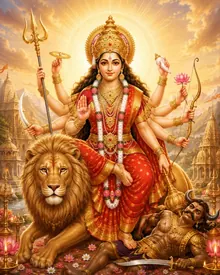
They explained the method, on the morning of Margashirsh Krishna Panchami, bathe, tie seventeen knots in a kumkum-dyed thread, worship it with sandalwood and agar, invoke Devi Annapurna, and wear the thread. Taking durva grass and akshat, worship the goddess with the mantra 'O Annapurna! Grant me food, wealth, sons, fame, long life, and health', men should wear this thread on the right wrist, women on the left. Thereafter, for sixteen days, listen to this katha with a focused mind each day and worship the thread. On the seventeenth day, Margashirsh Purnima, wear new clothes and complete the udyapan by installing, beneath a Kalpavriksha decorated with stalks of paddy, a beautiful image of Devi Annapurna, the colour of a hibiscus flower, three-eyed, adorned with the crescent moon of the second lunar day upon her brow, and eternally youthful.
Chapter 5 · Dhananjay's Prosperity and the Breaking of the Vow
Dhananjay took up the vow exactly as the celestial women had described, and, returning to Kashi, observed it faithfully. Within a single year his household came to possess wealth like Kubera's own; servants and maids as splendid as princes came to serve him, and, having found such prosperity in his youth, he also married.
Swept up in his prosperity, he grew indulgent and became absorbed in pleasure with his younger wife. One night, while he lay with her, his elder wife happened to see the vow-thread tied on his wrist. Filled with a co-wife's suspicion, she had a maidservant snap the thread and burn it in the fire. Dhananjay never noticed a thing, and when he found the thread missing from his wrist, he simply tied on a new one himself, without asking anyone and without repeating the proper rite.
But from that very day, his fortune began to wane, and within a single year all his wealth was gone. Reduced to begging, Dhananjay, tormented with worry, thought, alas! Someone has broken my vow-thread, and from that very day poverty has closed in on me again; now I cannot even get the alms I once could, whom shall I even ask how my fortune came to be destroyed?
Then he remembered that he should go to Kamarupa and ask those same celestial women the reason. Resolving this, he returned to that same spot, but there was no trace at all of the city, the lake, or the temple he had seen before, only dense, lifeless forest stretched all around, with not a single person, not even a bird. Wandering about, exhausted, Dhananjay thought, the vow-thread on my wrist was broken, my vow has been broken, so how can this sin bring me any benefit now? Surely it is my own misfortune that has made fate take everything away. Fallen from heaven, a vessel of grief, what use is it even to preserve these breaths, which will bring me nothing but further suffering?
Chapter 6 · The Divine Vision of Shiva and Annapurna
Saying this, he went to a nearby well, meaning to end his life, and threw himself into it. But the moment he fell, all his suffering vanished, and ahead of him he saw a divine light. Following the path of that light, he came into an utterly enchanting land, where lovely gardens, vines, and deer surrounded him on every side, peacocks danced, and koels sang sweetly.
Going further, he saw a lake as vast as the sea, blooming with lotuses, alive with swans and chakravaka birds. On its jewel-studded banks, celestial maidens were at play and at worship. From there came the sound of sweet, divine music, and, following it, the Brahmin approached a palace of crystal.
The moment he entered that jewelled pavilion, he saw a divine being dancing there, radiant and white as crystal, three-eyed, his brow adorned with the crescent moon of the second day, his hair matted, wearing serpents as ornaments. Before him, seated at ease upon a jewel-studded couch, was an utterly enchanting goddess, young and radiant, adorned with divine ornaments, attended by many celestial companions.
Astonished at this sight, the companions began asking who this stranger was. The terrified Dhananjay fell to the ground in full prostration, and his voice failed him entirely. Seeing this, one companion holding betel leaves comforted him and said: O Brahmin! The one whose vow you performed, desiring every kind of prosperity, is none other than Devi Annapurna, mother of the three worlds, by whose worship suffering and poverty are calmed, and who, when pleased, grants every kind of wealth. He who dances before you is Mahadev himself, the creator, sustainer, and destroyer of all, Shiva is the Purusha, Annapurna is Maya, and everything you see exists only through the power of these two. Who indeed can fathom the ways of such transcendent beings, so do not be amazed by this. O Brahmin, now resume, with devotion, the very vow you once saw those women performing on the bank of that lake in Kamarupa, by it you shall gain unbreakable fortune, fame, long life, and many sons, and even Indra shall never equal your good fortune.
Chapter 7 · Annapurna's Blessing and the Fruit of the Vow
Hearing this, Dhananjay prostrated himself once more and said: O Devi! Be pleased with me, remove my poverty and all my sorrow, and sustain me, O mother! This boundless ocean of the world is crossed by your sight alone, O Vishweshwari! I bow to you.
Then Devi Annapurna said: O Brahmin! Whoever in this world observes this auspicious vow of mine shall receive fortune from every side. They shall never suffer for want of food, nor be parted from those they love, nor shall misfortune ever befall them, they shall be renowned, handsome, generous, honoured by kings, righteous, and gracious in speech. I shall never abandon such people, and in whatever homes this story is read and heard, I shall dwell forever. Now take up this vow once more as before, build me a temple in the city of Kashi, on the southern side of Vishwanath Mahadev, and there, by my grace, I shall dwell with you always.
Hearing this, the pleased Mahadev said: O best of Brahmins! Our most beloved gana in Kashi, the cheerful-faced Dandapani, shall dwell there and, for the goddess's pleasure, ever provide food to the righteous. Those who observe this vow in this world shall never know poverty in their family, and, dying in the end at Kashi, shall all become our own ganas. Hearing this, Dhananjay bowed to Parvati and Mahadev, returned to Kashi, and observed the vow, and by Mahadev's decree he obtained everything he desired.
Shri Krishna said: O King Yudhishthira! I have told you of the best among all vows, by observing which even Shri Ramachandra regained his lost fortune. If you desire wealth, fame, and a good afterlife, O mighty-armed one, you must observe this vow together with your kinsmen, I myself always perform it with great devotion and faith. Those who, though they have the time and means, fail to observe this vow, remain forever sinful at heart, and anxiety never leaves them. In closing: salutations to Devi Annapurna, daughter of the mountain king, who grants the state of Vrishabhadhwaja Mahadev and fearlessness to her devotees, and upon whose brow the crescent moon shines.
How to Read Annapurna Mata Vrat Katha
On the morning of Margashirsh Krishna Panchami, bathe, tie seventeen knots in a kumkum-dyed thread, invoke Devi Annapurna, and wear the thread (men on the right wrist, women on the left). For sixteen days, listen to this katha each day and worship the thread, and on the seventeenth day, Margashirsh Purnima, complete the udyapan by installing an image of Devi Annapurna beneath a Kalpavriksha decorated with stalks of paddy.
About Annapurna Mata Vrat Katha
The Annapurna Mata Vrat Katha tells of the poor Brahmin Dhananjay's past-birth secret, his quest for the Annapurna vow, and, after the vow was broken, his direct vision of Shiva and Annapurna and the blessing he received. This page has seven chapters, the first covers Yudhishthira's question and the story of Rama and Lakshmana, the second Sage Agastya's account of Devadatta and Dhananjay, the third the past-birth secret, the fourth the quest for the vow and the meeting with the celestial women, the fifth Dhananjay's prosperity and the breaking of the vow, the sixth the divine vision of Shiva and Annapurna, and the seventh Annapurna's blessing and the fruit of the vow.
This vow begins on Margashirsh Krishna Panchami and is completed on Margashirsh Purnima. This page presents the full text of all the chapters in plain Hindi, with adjustable text size and print support.
The Annapurna Mata Vrat Katha itself identifies, at its close, as a tale from the dialogue between Shri Krishna and Yudhishthira in the Shri Bhavishyottara Purana. The text presented here is based on a published Hindi translation (rendered by one Bhattacharya of Muradabad) preserved in the Rare Books collection of the UP State Museum, Lucknow, transcribed faithfully here, using only the Hindi meaning given alongside the original Sanskrit verses, not the Sanskrit itself, with the source's considerable printing errors corrected as far as possible to follow the story's own flow, and no change made to the events or sequence of the story itself.
Frequently asked questions
How many chapters does the Annapurna Mata Vrat Katha have?
It has seven chapters in total, traditionally read or heard together as one complete text.
Why was the Brahmin Dhananjay afflicted with poverty?
In his past birth, Dhananjay was a Shudra named Heramba, who scattered and disrespected the sacred food brought as alms by sages, it was this fault that caused him to be born poor and without food in his next life.
What happened when Dhananjay's Annapurna vow-thread was broken?
Out of jealousy, Dhananjay's co-wife had his vow-thread broken and burned, and Dhananjay tied on a new one himself without repeating the proper rite, from that very day his wealth began to decline, and within a year he became poor once again.
What relationship between Shiva and Annapurna does this katha describe?
According to the katha, Shiva is the Purusha and Annapurna is his Shakti (Maya), in creating and sustaining the world she is called 'Annapurna', and in destruction 'Kalratri', so that, though one, she manifests in three forms.